What You Need to Know to Trade Antiques
This is a question all antiques dealers should ask themselves: Practice you lot accept products looking for a market place, or do you lot await for products that fit your marketplace?
Nigh of us in the antiques business are product-focused rather than market-focused. When we are out picking, nosotros wait for unique items that we can purchase depression and sell high. Who might buy an item is normally an after-thought.
This methodology is commonplace in the antiques trades. Joe Willard, author of The Pickers Bible: How to Option Antiques Like the Pros suggests that our antiques inventories are harvested.
"The fact is, the bulk of the inventory that many dealers have originated from the front lines of picking," Willard says. "What you see in an antiques store or a museum is an assemblage of items. It didn't only happen. It was built over many years of gathering, finding, trading and collecting. It was all harvested"
Harvesting is a expert analogy. A farmer harvests his crop regardless of what the market is for his production. When soybean prices are down, farmers still selection their crop and sell it for what the market will conduct, regardless of how much information technology cost to produce the crop.
Antiques dealers are very much like this; like farmers, nosotros harvest when the crop is fix to exist picked. Whenever we are out-and-well-nigh and find something that is ripe-for-the-picking, we buy information technology and add together it to our inventory. We harvest our crop and promise that someone will buy it at a assisting cost. Antiques dealers have survived in this way for over 100 years. Many dealers will operate in this way forever.
Marketplaces have evolved
Today's market is unlike anything that's been seen in the past. Both competition and product supply are at unheard-of levels. More than 10 years ago, in my offset cavalcade for Antique Trader, I addressed the new marketplace reality:
"In America today, there is a paradigm shift occurring that volition completely restructure the antiques business concern. What are the main drivers of the new image? There are two: a presentlyhoped-for crushing overabundance of supply and universal distribution.
Courtesy of yardsales.internet
Universal distribution challenges antique stores
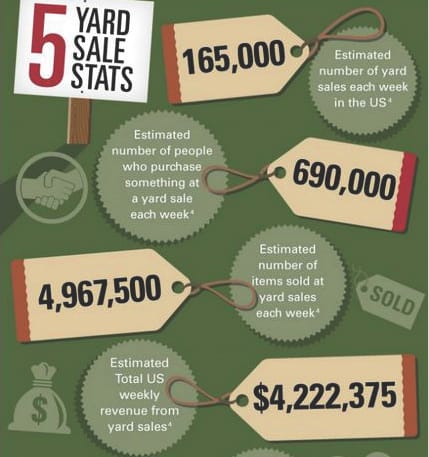
A generation ago, the majority of antiques and collectibles were housed in antique stores. Not anymore; antiques sales have moved from bricks-and-mortar to yards, homes, and (for online sellers) desktops. Everyone sells antiques and vintage; marketplaces have exploded. Alive auctions, online auctions and ecommerce, manor sales, thousand sales, flea markets, and consignment shops are ubiquitous. An infographic published by Yardsales.internet illustrates only how competitive the market is each week in the U.S.
Yard sales: 165,000
Buyers (purchasers): 690,000
Items sold: 4,967,500
Revenue: $four,222,375
That'southward roughly $220 one thousand thousand almanac revenue from k sales alone. Combined U.S. resale markets total billions of dollars per twelvemonth, and not much of it occurs in antiquarian stores.
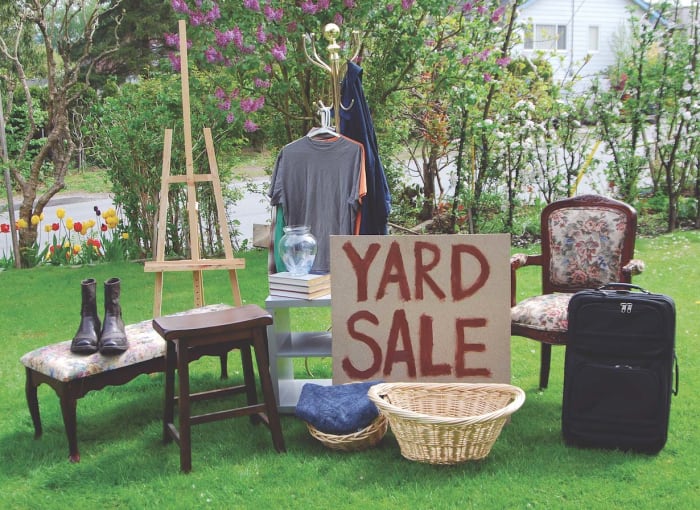
K sales are only ane challenge for antiques and collectibles businesses.
Image courtesy Getty Images
Marketing focus in three steps
Antiques dealers cannot sell their appurtenances at yard-sale prices; neither can they accept low-ball bids. How, and then, can they compete in today's market place? By focusing on a selling channel and researching a marketplace before developing a marketing strategy and spending coin. In that location are iii steps to accomplishing this:
Step One: focus on a selling channel
In that location are iii antiques selling channels; each channel requires a unique set of skills and marketing tactics:
i. Bricks-and-Mortar (B&Yard). Bricks-and-mortar retailing is customer-oriented; information technology's well-nigh creating a memorable shopping experience. Retailers focus on merchandising, traffic flow, websites, social media and local search. Retailers marketplace locally. Customers call up the store in which they made a buy.
2. Online selling is production oriented. Online buyers search by product proper name or category. Customers remember the online marketplace on which they made a purchase. They won't remember the name of the business concern that sold them an detail; they will say to their friends "look what I got on eBay!" Online selling requires the ability to write effective product descriptions, take swell photos, create lots of listings quickly, and pack and ship in a timely fashion.
3. Being a mobile (shows and fairs) antiquarian dealer is time-consuming and exhausting but allows time between shows for picking. Customers will remember the show at which they fabricated a purchase, but they won't recollect the booth or dealer.
Each selling channel has detail expenses and workflow. For most of us, in that location isn't plenty time in a week to do everything. These channels can be profitable, but if you determine to employ them simultaneously you volition sacrifice both quality and profits.
Step Two: research
Inquiry begins by learning who the buyers are for what you have to sell (demographics): Where do they live? How much coin do they earn? What's their educational level? What are their buying habits? Marketing is like archery: you must know what your target is earlier you tin can striking it. Enquiry defines your target. This data is available online if you dig for it. For example:
If your focus is online collectibles, hither is some insight from IBISWold.com.
If you're selling vintage appurtenances, Marketing Artfully provides a adept analysis of who your buyer is.
Merchandise Associations pop up around identifiable niches, like antiques, musical instruments, crafts and hobbies, toys, and and so on. Associations sometimes collect and publish criterion information, including demographics of the niche. To see if a merchandise association exists for your specialty, google the specialty (for example, "toys") and the words "trade clan."
Notice more about your market by visiting the United States Census Agency.
Image courtesy United States Demography Bureau
Once you know who your target client is, find out how many similar people alive in your market area. This is the group you will market to. Your starting point will be the U.s. Census Bureau, which collects data on many aspects of the U.S. economy. The USCB has a data portal titled Demography Business Architect: Small Business Edition that allows easy access to demography data for your locale, and for most business types (antiques and collectibles dealers fall under the general "used merchandise" category).
The site "provides easy access to information almost the residents and businesses to aid you lot open or aggrandize your business…presents primal information that entrepreneurs and small concern owners need to better understand their market." Links to video tutorials ("Assist & FAQs") and downloadable instructions ("Overview") are included.
Pre-assembled reports using demography information are available through companies similar Dun & Bradstreet and IBISWorld, but they can exist expensive. Sometimes these market reports can exist had for free at your public library. Libraries subscribe to many types of databases; for example, the Lancaster, Penn., library offers access to four meridian-tier business organization databases.
Pace 3: develop a mailing list
Regardless of the selling channel used, you must develop a customer mailing list. Your customer list is your business: not your B&1000 store, your online listings, or your bear witness circuit. Sellers come-and-go. Buyers don't demand you lot; they have lots of shopping options. But shoppers prefer to deal with someone they know, similar and trust. Regardless of your selling channel, your marketing should focus on developing your customer mailing list.
Today'southward dealers are buried in economic racket and sales messages. For your message to exist heard conspicuously, y'all must decide who you lot are going to talk to and then give them something worthwhile to listen to. Equally Dr. Philip Kotler, "The Father of Modern Marketing" explains:
"Marketing management is the fine art and scientific discipline of choosing target markets and getting, keeping and growing customers through creating, delivering, and communicating superior customer value."
For More Tips and Advice From Wayne Jordan: The Business of Antiques
Source: https://www.antiquetrader.com/collecting-101/three-steps-to-antiques-marketing-success
0 Response to "What You Need to Know to Trade Antiques"
Post a Comment